On St. George’s Day April 23rd 2019

Ring for England - St. George's Day: April 23rd - 6pm Ring for England - St. George's Day: April 23rd - 6pm Ring for England - St. George's Day: April 23rd - 6pm Ring for England - St. George's Day: April 23rd - 6pm Ring for England - St. George's Day: April 23rd - 6pm Ring for England - St. George's Day: April 23rd - 6pm

A Famous College in the city of OXFORD will ring April 23rd

The world famous city of OXFORD has, as one of its oldest colleges, MERTON COLLEGE founded in 1264 by Walter de Merton, a Chancellor of England and later Bishop of Rochester.  It is famed for its library that is the oldest continuously working library for students in the world.  Its chapel, dating back to the 13th C has a most accomplished choir and a ring of 8 bells which will ring out for ST. GEORGE’S Day.

OXFORD - Merton College

ST. ALBANS and Hertfordshire will be joining in for ST. GEORGE

Today, the city of ST. ALBANS, built on the ancient Watling Street in Hertfordshire, was known as Verulamium, and was the second largest settlement in Roman times outside of Londinium.  It became known in its present form after a Roman British citizen named Alban, who at the end of the 3rd Century AD stood trial in place of a priest he had helped to escape and was condemned to death for refusing to give up his faith.  His martyrdom inspired pilgrims to The Abbey that was founded by King Offa in 793.  This venerable building ‘The oldest site of continuous Christian worship in Britain’ is still a site of pilgrimage and has had bells rung from its tower since 11th Century.  Today, this tower is the earliest remaining Norman tower in the country and has a ring of 13 bells.  These will be rung for ST. GEORGE and their celebration will be heard for miles around.

ST. ALBANS Cathedral

Another Yorkshire Cathedral – SHEFFIELD will be ringing

The city of SHEFFIELD dates back to the 1st millenium AD when a settlement was created in a clearing beside the River Sheaf.  Later, after the Norman Conquest, a castle was built on the site. Then a local William de Lovetot built the first church in the 12th C on land at the other end opposite this castle and the township of Sheffield became established.  Over the years the church was added to and so too the town grew later becoming a world famous center for steel in the Industrial Revolution. But it was not until 1914 that the church was granted the status of a Cathedral and among the additions to the original building came the St. George’s Chapel. This chapel was set aside to honour the city’s many lives lost during various conflicts, not least those that were on board HMS Sheffield when it sank in the Falklands war.  As a reminder of this connection the chapel holds the ship’s bell.  For the Cathedral’s other bells they number 13 and they will be ringing out across the city for ST. GEORGE’S DAY.

SHEFFIELD Cathedral


More churches in Herts including a ST. GEORGE will be ringing

More churches from Hertfordshire are joining in including a special ST. GEORGE’S in the village of ANSTEY.  This village with Anglo Saxon origins has a delightful medieval church dating from 12th C.  It has strong connections with the military which include graffiti from the 13th C and more recently with many American airman based nearby who lost their lives during  WWII. Its 6 bells will be ringing loud and clear for ST. GEORGE.

ANSTEY - ST.GEORGE Herts

A Magisterial Minster – YORK will ring for ST.GEORGE on April 23rd.

The city was founded by The Romans in 71AD and was known as ‘Eboracum’, situated strategically at the confluence of the rivers Ouse and Foss and became the Roman capital of the interior.  Today, this city, now known as YORK, is still a capital of the interior and also of its county.  It has many historic features but none so important nor influential than its magnificent Minster.  A church had been established on this site since the 4th Century and over the years it has been rebuilt after fires, wars and invasions.  The sublime and magisterial building it is today brings visitors from all over the world to admire its architecture including its towers.  The North West holds the bell ‘Great Peter’ the fourth largest in the country weighing just over 216 cwt.  In the South West there are 14 bells that are hung for ‘change ringing’ and they will be making a thundering good sound across the country as they ring out for ST.GEORGE, April 23rd.

Minster YORK

Another great Newcastle church – ST.GEORGE’s Jesmond will be ringing.

The great city of Newcastle has an area known as JESMOND and herein sits a very special church – ST. GEORGE’S.  It was built in 1888 and the entire building is a great testament to the Arts and Crafts Movement and Art Nouveau styles.  Its interiors are covered in stunning mosaics that have hints of Ravenna and its tower follows that of St. Mark’s in Venice.  This amazing structure stands 154 feet high and from this tower its 8 bells ring as they will on April 23rd for ST. GEORGE.

JESMOND-St-George-Exterior


Another great Cathedral – MANCHESTER will ring for ST. GEORGE

The Romans built a fort here and named it ‘Mancunium’ and from out of this settlement grew today’s great city now named MANCHESTER.  Its growth and fame grew as the textile industry exploded and thus it became the world’s first industrial city as a result of the Industrial Revolution. It was in 1853 that it was declared a city and is now the third most visited by foreign travellers. The cathedral is built with the widest naves in the country and is the only one in England to be dedicated to ST.GEORGE. Within its grounds is the oldest public library wherein Karl Marx studied and conversed with Engels.  It suffered terribly during WWII and again by the IRA but through the stamina and resoluteness of its citizens it has been restored and its 10 bells will be ringing out and reminding Manchester that it is ST.GEORGE’s Day.

MANCHESTER Cathedral


The Cathedral of the SURREY Hills will be celebrating

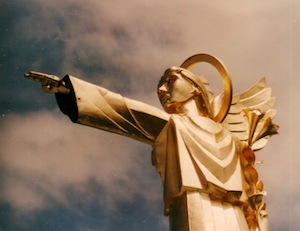
The origins of the city of GUILDFORD were based on it being a settlement that grew as a stopping point on the Pilgrims Way between Canterbury and Winchester.  After the Battle of Hastings William the Conqueror recognizing its strategic importance took ownership and then built a castle of which only the tower remains. The town soon grew in importance and eventually became the capital of the County which was made a Diocese in 1927 but it was not until the present building was a cathedral built.  Stag Hill was the appropriate site chosen as it was the hunting ground of former Kings and has a spectacular view over the whole county. The building is of bricks all paid for by the public who had their names inscribed on each donation.  It was consecrated in 1961 and the final act in the completion was the placing of a gilded angel on top of the spire.  This statue turns with the wind reflecting the sun’s rays, and as it turns so do the cathedral’s 12 bells ring out  as they will to celebrate ST. GEORGE’S DAY.

GUILDFORD - Golden Angel


The Bell of LIVERPOOL Cathedral ‘GREAT GEORGE’ will be ringing

LIVERPOOL Cathedral

This great city overlooking the River Mersey was acknowledged as a worthy settlement by King John in 1207.  Overtime it later became known as LIVERPOOL and today it has an astonishing building high up on St.James’s Mount where sits its Cathedral which can be seen by its entire metropolis. This building was based on a designed put forward in 1920 but not completed until 1978 in the presence of The Queen.  It is not only the longest cathedral in the world, but has a bell tower that is one of the tallest in the world.  As if two superlatives were not enough it has a third – it has the highest and heaviest peal of bells in the world holding 13 known as the Bartlett Bells.  These surround the heaviest named ‘GREAT GEORGE’ which at 14.7 tonnes is the third heaviest in the country. This magnificent beast will be rung to celebrate its namesake ST. GEORGE on April 23rd.

SUSSEX will join in with CHICHESTER ringing

The south coast is blessed with a wonderful cathedral whose spire ascends to a great height and can be seen for miles including out to sea.  The name CHICHESTER comes from the Saxon name ‘Cissa’ to which they added the word ‘ceaster’ meaning a group of Roman buildings and thus it became Chichester. The Romans settled here building a fort in 44AD and calling it Noviomagus and evidence of their presence was discovered in the 1960s when they unearthed an astonishing Roman Palace at nearby Fishbourne. It became a Cathedral in 1076 and today houses the most impressive collection of modern art. From a window by Marc Chagall whose colours strike a resonant kaleidoscope across the medieval stonework, a tapestry by John Piper and a painting by Graham Sutherland. It marries the monastic calm with the vibrant modern. Richard of Wych was Bishop from 1245-1253 and was later canonised and became Saint Richard in 1262.  The bells are housed in a separate tower and these, numbering 8, will be ringing out for all to hear for ST. GEORGE.

CHICHESTER Cathedral